How Casting Simulation is Revolutionizing Steel Foundries
Modern steel casting foundries are increasingly relying on predictive simulation technology to achieve near-zero defect rates. At Atul Precision Cast, we deploy advanced casting simulation software to model the entire solidification process before the first mould is poured drastically reducing trial costs and accelerating time-to-market.
What is Casting Simulation?
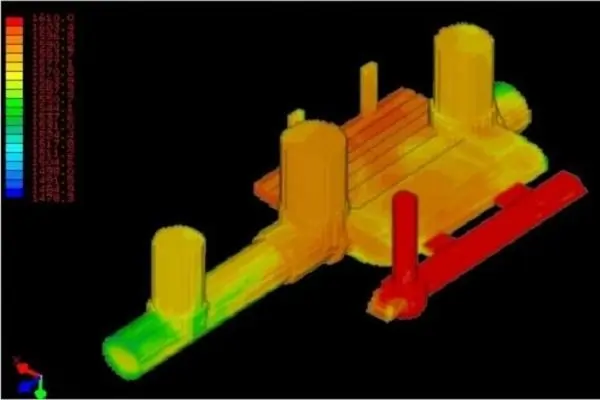
Casting simulation uses computational fluid dynamics (CFD) and finite element analysis (FEA) to digitally replicate the metal filling, solidification, and cooling phases of the casting process. The software predicts potential issues such as shrinkage porosity, hot spots, misruns, and gas entrapment allowing engineers to optimize the gating system, riser placement, and cooling strategy before committing to physical production.
Key Benefits of Predictive Simulation
Reduces physical trials by up to 80%
Predicts shrinkage cavity locations with 95%+ accuracy
Optimizes metal yield by refining gating & risering
Validates thermal behaviour of complex geometries
APC's Simulation-First Approach
Every new component at APC goes through rigorous simulation before tooling is initiated. Our engineers create 3D models of the casting, along with its gating and risering system, and run multiple simulation iterations to achieve optimal filling and feeding. This simulation-first approach is particularly critical for our hydro turbine components and large pump casings where internal soundness must meet stringent radiographic (RT) acceptance criteria.
The result? Castings that consistently pass Level 2 (or better) radiographic quality on the very first production batch a benchmark that sets APC apart from conventional foundries that rely on trial-and-error methodology.